
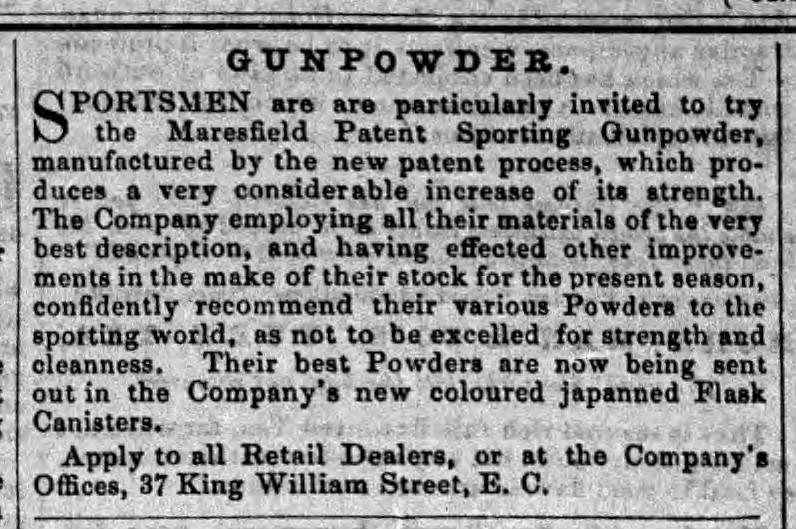
The Powder Mills were erected on the site of one of Maresfield’s larger ironworks – The Forge, about 1830. The company of Drayon and Hervey was formed and gunpowder production commenced.
| Year | Key events |
|---|---|
| 1543 | First English cannon cast at Buxted by Ralph Hogge, who also owned Marshalls Manor at that time |
| 1608 | James 1 had 100 tonnes of silver ore from Scotland smelted at Maresfield; the relative ease of navigation up the Ouse helped with transportation |
| 1629 | Cardinal Richelieu, at the invitation of Sir Sackville Crow, sent M. Donevide from France to “Powder Mills” furnace and forge |
| 1724 | Budgen’s Map showing forge and furnace (in the wrong place!) |
| 1735 | Coal as a substitute for charcoal process perfected in Shropshire |
| 1736 | Powder Mill forge producing 60 tons of iron annually |
| 1737-1750 | Exceptional Drought |
| 1749 | Powder Mill forge shown on Bowens Map |
| c. 1750 | Closure of Powder Mill furnace |
| 1760 | Carron ironworks founded in Scotland |
| 1769 | Powder Mills and others lost naval gun contracts to Carron |
| 1788 | Powder Mill forge producing 30 tons of iron annually |
| 1812 | Closure of Powder Mill forge |
| 1820 | The last Wealden forge closed |
| 1822 | The forge and cottages shown on Gage estate map |
| 1849 | Gage sold to Shelley, who began to build Powder Mill, new cottages and renovate the old ones |
| 1852 | Maresfield Patent Gunpowder Co. Ltd (Powder Mills) leased to Henry Drayson of Framfield |
| 1856 | Mills destroyed in explosion. Abbey’s Lake was breached and drained |
| 1859 | Maresfield Patent Gunpowder Co. Ltd bankrupt. |
| 1931 | Lake rebuilt and flooded again by Abbey |
| 1977 | Last Powder Mill cottages, built by Shelley, burnt down |
A small community developed round the site including a village store and chapel. Despite their ideal geographical position they were not successful and after two explosions and loss of life, closed about 25 years later.
In 1856, an explosion at the Powder Mills claimed the life of James Ellis, a “most experienced workman” who died when two of the mills exploded.

THE LATE FRIGHTFUL AND FATAL EXPLOSION AT THE MARESFIELD POWDER MILLS
The dreadful explosion which took place last Friday at the Maresfield Gunpowder-mills, by which one human life was instantaneously sacrificed and several others were placed in imminent jeopardy, remains so far as its origin is concerned—enveloped in mystery, and its real cause must for ever remain a matter of mere conjecture, as the poor fellow who lost his life was the only person who could by any means throw a light on the subject.
From the evidence taken before the coroner, on view of the body of the hapless deceased, James Ellis, it appears that the Maresfield mills, which are in the occupation of the Messrs. Drayton and Co., supply a large quantity of gunpowder, and consequently the works are on a very large and extended scale. The deceased, a most experienced workman, had been in the employ of the company a long period, and he had charge of three mills near the engine-house.
On the morning of the lamentable occurrence he was at his usual work attending to the mills, when suddenly two of the mills, the one he was in and another, exploded, the noise of the explosion being heard for miles round. The force of the concussion was also very great, Mr. Batchelor, the engineer, who was in the engine-house at the time, being thrown violently down, and a workman named Geer, who was sitting in the open air at some distance from the buildings, being hurled from the stool he was sitting on to the ground with much violence. Another workman, named Pimphrey, who had just quitted the mills with a hundred weight of loose powder in a barrow, had likewise a most narrow escape.
Immediately after the explosions, for it was stated by those who saw and heard them that two distinct ones took place, the shattered buildings were entered, when Ellis was discovered lying near the door. His body presented a frightful appearance, and his clothes were at the time on fire in several places. It was found that life was not quite extinct. Aid was quickly sent for, but he expired in a few minutes.
None of the witnesses could give any opinion as to the cause of the catastrophe, with the exception of the man Pimphrey, who had been with the deceased a second or so before, and who expressed his opinion that one of the mills had been overcharged. Another witness, named Matthews, in speaking of the great want of caution in such buildings, stated that he had known thirty-eight men killed by explosions, while he had been connected with the manufacture of powder, for thirty years. It further appeared that there were 42lbs. of powder in each mill at the time of the disaster. A verdict of accidental death was recorded.
John Villiers Shelley moved the low wooden buildings to Flitterbanks Farm in the Park where for over a century they served as substantial cow sheds and agricultural buildings. The Manager’s house in the wood, because of its complete isolation, could not attract a tenant so was pulled down.
One interesting relic of these days of industry remains in the form of a circular stone about 6ft in diameter on which the mortar was fixed for testing the strength of the powder. An old village yarn says that Mr Abbey, the steward of the Estate, sold the stone to a gentleman for ten shillings. Although the purchaser was sure it was just what he wanted, he was never able to move it!

Two cottages known as ‘Powder Mill Cottages’ remained and were occupied up until a mysterious fire destroyed them in 1977.

Leave a Reply
You must be logged in to post a comment.