
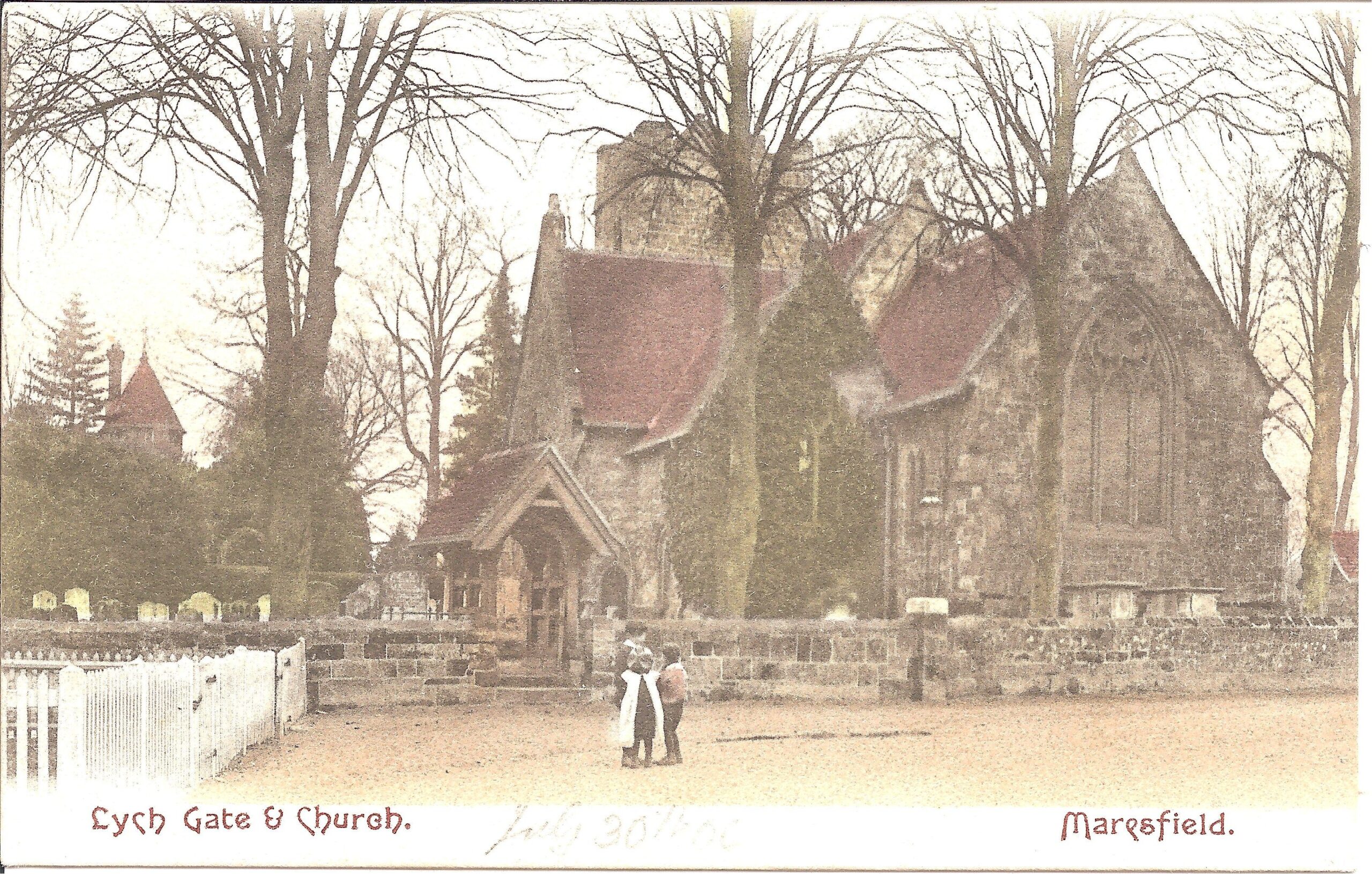
Like most villages, the church has always been the focal point of Maresfield. A wooden church is believed to have stood on the same site in Saxon times. The late Revd Algernon Charles Dudley Ryder (Rector 1902-1941) was always adamant that the little window on the south side of the nave was of Saxon origin.
The present church is a simple but impressive structure of Early English style, with nave, chancel and two transepts.


The church was restored in the ministry of the Revd John Banks Meek Butler in 1872 assisted by Lady Shelley, Sir Spencer Maryon-Wilson, Bart (of Fletching), Mr and Mrs Pechell (daughter and son-in-law of Lady Shelley), Mr Nesbitt (of ‘Oldlands’), Mr Barchard and Mr Streatfeild (Squire of Uckfield).
A gallery was removed which opened up the full beauty of the west arch and the two transepts gave back the accommodation lost by the removal of the gallery. The square pews were also removed at this time. There were two large square box pews with seats all round, one belonged to the old people in the parish workhouse which was on the Tunbridge Wells road, and the other to the village shop keeper and his staff. The other square pews were allotted to ‘Marshalls Manor’, ‘Strethouse’, and one raised aloft and supported by iron bars for the Shelley family. All pews were high and with doors on which the name of the house to which each was assigned was painted.
The old font was returned to its original position near the north door having been found abandoned about 1820 in Chapel Wood, it then served as a cattle trough in the farmyard until rescued by the Revd Edward Turner and left in his garden until the Revd Mr Butler brought it back to its rightful resting place. It is circular and of crude workmanship and was originally supported by six attached shafts with a centre one through which the water drained.
Visitors to the church are always impressed by the beautiful stained glass windows, especially the east window, of soft and delicate colouring executed by Messrs. Powell and erected for Mrs Nesbitt in memory of her husband, Alexander Nesbitt. The central division represents the crucifixion; on the left Jesus is carrying His cross to Calvary; on the right His body is being taken down from the cross.
The Rectors of Maresfield are recorded from 1404.
The Parish Chest contains a book recording a most thorough and methodical account from 1664 to 1752 of church collections. Amongst other churches assisted are the following recordings:
| 1664 | Withyham (Sussex) | 7/ 8½d |
| 1671 | Waltham Abbey (Essex) | 5/- |
| 1720 | Oxtead (note the spelling) | 1/6d |
| 1751 | Storrington (Sussex) | 4/6d |
| 1678 | Rebuilding St Paul’s Church in London | £1-1-1d |
The briefs are very numerous for churches suffering fire damage, including October, 1666 – collected towards the relief of the poor sufferers by the late exceeding Great Fire in London – 13/2d.
A variety of other deserving causes included:
| 1665, October | Collected towards the relief of the poor visited by the Plague of London | 9/- |
| 1739 | Upon Standen loss by hail storm | £1-1-6d |
| 1741 | For the Oyster Dredgers | 2/9d |
| 1744 | For the Fisherman of Faversham | 8/1d |
| 1715 | Collected upon the brief for the cowkeepers (The loss of cows due to an infectious and malignant distemper) | 13/2d |
| 1701 | For the slaves in Morocco | 13/- |
Parish Registers were introduced after an Act of Parliament in 1538. For the first hundred years or so, not only were baptisms, marriages and funerals recorded but general parochial information. These old registers record many curious customs. Maresfield registers are very complete apart from 1811 when the Register was probably destroyed when the Rectory was burnt down. Especially interesting entries include sponsors given at baptisms between 1556 and 1588. In 1559 the name of John Cade appears and in 1571 Thomas Cade – were these relations of the notorious Jack Cade who led the rebellions?
From May 1695 to April 1697 the burial charge was 4/-, and 2/- for baptisms.
| 1642 | Mary Turner, the daughter of Nicholas Turner of Ffarley near Maidstone in Kent being in the fight (the Royalist troops under Sir Ed. Ford and the Parliamentary forces led by Sir William Waller) at Chichester and travelling homeward his wife was delivered of the said child in this parish and was baptised on the 22nd day of February. |
| 1664 | Baptised Ursula Morgan the first child baptised after the new fashion. (The ‘new fashion’ was the sprinkling or pouring on of water instead of the ‘dipping’ method previously used) |
| 1744 | Buried William the son of George Feldwick who was killed shooting on the Lord’s Day. |
| 1745 | Buried August 18th Old John Smith the shoemaker of the Batts. |
A new register beginning in 1653 cost six shillings and was described as ‘a long narrow book very imperfectly finished with parchment covers and 21 parchment leaves’. The 1685 register book cost ‘tenn shillings’.
There is a peal of eight bells in the fine embattled tower which was added to the church in the early 15th century by John de Pelham, one of the powerful family of Sussex landowners. There were originally six bells that were recast in 1787. An old parish account book records the taking down and rehanging of the bells cost £23-10-0, an expense that was defrayed by a special church rate.
Two bells were added in 1950 during the ministry of the Revd S.B Latham given by Mr and Mrs F.J. Bellingham of ‘Southern Cottage’, Maresfield Park in memory of their daughter Marjorie, who died of tuberculosis in 1941 and Mrs Rundle (formerly Mrs Robinson) of ‘Berigem’, Maresfield Park in memory of her son. The bells were dedicated at a Thanksgiving Service for Victory to which the Revd F.H. Sheldon (Rector for most of the war) was invited.
The older part of the churchyard was closed about 1860 and at the restoration a fresh piece of ground was added in which the graves of some of the more recent Rectors of the parish can be found. The cemetery in School Hill between ‘Sandrock’ and the school was originally a piece of rough ground where the parish stocks stood.
The lych gate to the north entrance of the church is made of oak, grown on the Maresfield Estate and was erected in 1896 by Mr and Mrs Pechell in memory of Mrs Pechell’s mother, Lady Louisa Shelley who died the previous year.
The iron gate on the north west side was given to the church by the members of the 163rd Infantry O.C.T.U. in 1947 in appreciation for the use of the church during their stay at Maresfield Camp.


Extract from “Maresfield”, by Betty Turner , © 1991 Betty E Turner
Leave a Reply
You must be logged in to post a comment.