
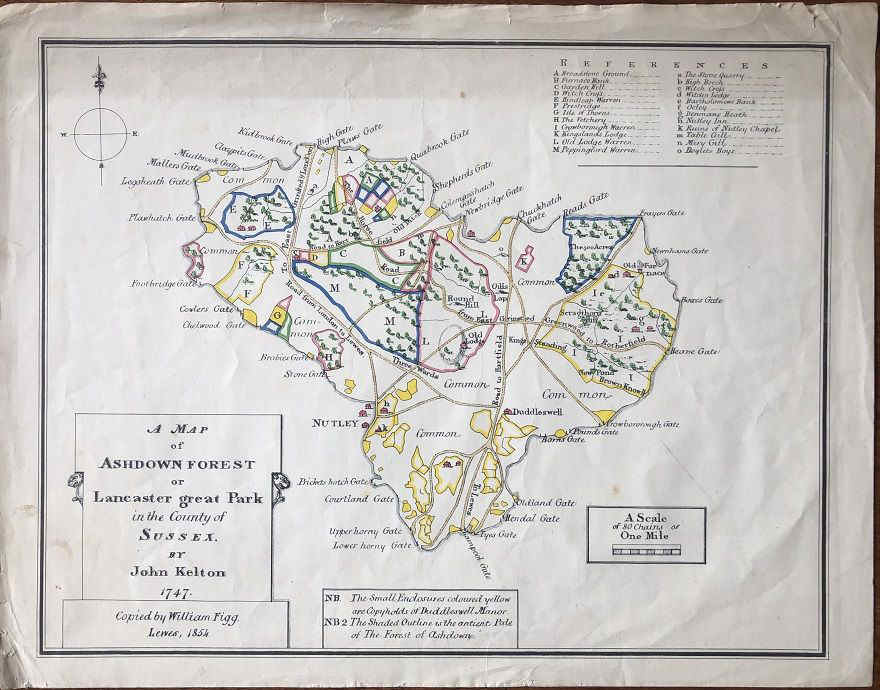
In Saxon times, areas of Kent, Sussex, Surrey and Hampshire formed The Forest of Anderida or Forest of Pevensey.
Ashdown Forest was part of this great wild area. About 14,000 acres between Tunbridge Wells and East Grinstead were given by King Edward III to his third son, John of Gaunt, Duke of Lancaster under the name of Free Chase of Ashdowne.
For the next 300 years Ashdown Forest or Lancaster Great Park as it was also called was preserved as a royal hunting ground.
The survey of 1658 shows the forest divided into seven wards each with a lodge and keeper. Many names are still in use today e.g. Coleman’s Hatch, Clay Gate, Chuck Hatch and Friars Gate.
Over the centuries many attempts were made to enclose the forest by people leasing from the Crown. These moves were strenuously opposed by the Commoners who, as tenants of the various manors e.g. Maresfield and Duddleswell, claimed their forest rights to pasture, turf, litter etc. and broke down the fences as soon as they were erected.
In 1881 a successful law suit by the Commoners gave them the rights to continue cutting heath and bracken for litter and preserved their rights and privileges which today are protected by a body of conservators chosen from amongst themselves.
Today Ashdown Forest is a popular spot for many forms of relaxation including walking and pony trekking.
The forest was purchased by the East Sussex County Council and vested in the Ashdown Forest Trust.