
by Gordon Marsh.
First published in 2003 by Maresfield Conservation Group.
IN JULY 1928 the Marsh family — Dad, Mum, Marjorie and I — moved from a tied cottage on a farm in Laughton to the then growing village of Maresfield. It was a good move so far as I was concerned. It had been a lonely life on the farm and it didn’t lessen the pain by having a one-and-a-half mile walk to and from school every day. So moving to Maresfield was an exciting prospect. Initially, we lived at “Lindens”, next to the Post Office as it then was and opposite Wickhams Store. This meant that Marj and I had only a short walk to Bonners School and so were able to come home for lunch every day. Furthermore, the recreation ground was virtually on our doorstep. We soon settled in. Father was busy with his milk round and mother used one of the front rooms of the house as a café serving home-made cakes, sandwiches and tea, chiefly to the soldiers who, at the time, were based at their camp in Maresfield Park. We also took in a lodger, a Miss Marshlain, who taught the infants at the village school.
School days were quite happy although our headmaster, Mr. Albert Cosham (for some obscure reason he was nicknamed “Mickey”) was very strict and would use his cane if he felt it was necessary. His wife, who taught the 7 to 9s, also seemed at first to be a very stern lady but as time went by she revealed hidden depths of kindness. They were both greatly respected and Mr. Cosham, especially, had many diverse interests. Not only was he the church organist, but he helped Miss Phillipa Ryder, the Rector’s daughter, to train the choir. He was also a first-class cricketer being captain of Maresfield’s 1st XI and a fine coach for the colts. Knowledgeable spectators would say that they could always pick out a Cosham-trained batsman.
The Rector at this time was the Rev. A.C.D. Ryder who served the village from 1902 to 1941. He knew everybody by name and was loved by us all. He could always be seen walking around his parish visiting the sick, church-goers and non-church-goers alike, invariably bringing fruit and eggs for the housewife, a pack of “baccy” for hubby and sweets for the children.
A difficult decision for local children was the choice of Sunday School – Maresfield or Five Ash Down Chapel. They both had good Christmas parties so it wasn’t an easy decision. But the problem was solved for most of us by going to both parties, the church in the morning and the chapel in the afternoon….
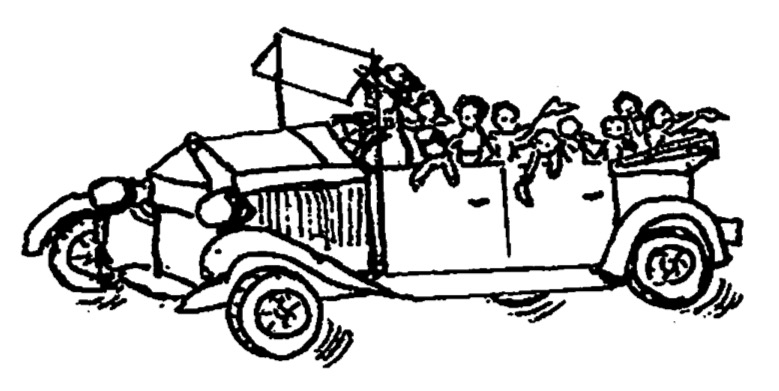
The outings run by Miss Ryder were an added attraction for the Maresfield Sunday School. Often she would take us for picnics in the family tourer, a commodious Essex Terraplane—and if you remember that particular model you must be as old as I am!

Twice a year we looked forward to The Church Army horse-drawn caravan arriving at the Chequers Inn. Captain and Mrs. Martin, who lived in Underhill, toured the district holding informal open-air Anglican services. This was always a big attraction, especially for the children, as the service was always accompanied by a generous supply of cakes, biscuits and lemonade. Another local evangelist was the Uckfield Insurance agent and strict Baptist, Mr. Basil Johnson who, if he spied a group of four or more people chatting together, would waste no opportunity to expound the benefits of his religion. Then, when he had completed all his calls in the village, and had mounted his bicycle this was the signal we kids were waiting for. As he pedalled home towards Uckfield, we would run behind him singing “Jesus loves me, yes I know, ‘cos Basil Johnson told me so.” Well, after all, we were only children….
The A22 and the A272 in those days were the principal routes through Maresfield village (with the coming of the bypass the village is now served by two secondary roads, the C33 and C34). But even with a bypass these two secondary roads are still infinitely busier than they were when I was a boy. In fact, a gang of us kids was able to prevent reckless speeding by playing hopscotch in the middle of the road opposite our house and Wickham’s Stores! Occasionally we would be disturbed by one of Hobden’s steam wagons plying between the firm’s distribution centre in Chailey and the old Southern Railway station in Uckfield. These wagons were so noisy that when we heard them negotiating the junction at the Chequers Inn we would nip back smartly onto the pavements. London Red double decker bus service No. 407 ran an hourly service, each way, from Thornton Heath to Uckfield. The local bus, No. 89 ran from Haywards Heath to Uckfield and the 119 took passengers from Tunbridge Wells to Brighton. Accidents were unheard of.
Wickham’s Stores in those days was very large for a village shop and it sold virtually everything from kindling wood, paraffin, household soap, soda crystals, pegs, clothing, footwear, and, of course, a vast range of groceries, fruit, vegetables, cheese, bacon cut to your required thickness!
For the discriminating drinker Wickham’s tea was available, specially blended, according to Mr. Wickham, to suit the local water. Furthermore, the entire store (there were two floors) was always spotlessly, clean. Personal service was the byword and customers could leave their grocery orders which invariably would be delivered by van later in the day.
The village butcher was what is now Prospect House, at the entrance to the recreation ground. It was owned by Mr. A.J.H. Bayley whose daughter, Marion still lives with her husband, Bernard, on the outskirts of the village at Budletts. Behind the shop were a number of outbuildings where sides of beef were cut into joints and where the sausages were made. Mrs. Hilda Bayley was the cashier and, as with all village shops, there was always plenty of gossip to exchange. Around 1931-32, Vic Billing helped Mr. Bayley by driving the delivery van. Vic never learned to drive. Instead, Mr. Bayley took him in the van onto the recreation ground where he explained the basics of driving to Vic who then drove the van around the ground a couple of times, reversed between two objects and was then pronounced sufficiently experienced to drive—which from then on he did. Vic also made the sausages and on one occasion he lost the top of his finger in the mincer. It was never found and we shall never know…. Vic lives in Uckfield today but his sister, Joan Dyer, is still with us in the village.
The village had no newsagent in those days. Neither was there one in Piltown or Fetching. There was clearly a need for one and so a local man, George Chatfield, stepped into the breach and purchased a delivery bicycle fitted with a large waterproof container which he fitted to the front carrier. He also had two large panniers suspended from the rear carrier. George was an ‘entrepreneur’ in today’s parlance but he was not an ambitious man and remained a cycling newsagent most of his working life. And a hard life it was, too. Every day he would have to meet the 5.30am mail train at Uckfield station (a very important goods depot in those days, handling every conceivable merchandise for the whole district), sort out and mark up his papers in the booking hall before cycling, fully loaded, back to Maresfield. With the “village round” finished, it was home for a quick breakfast with his wife and two children before setting out the next stage of his round to Down Street and Splaynes Green, Piltown then on to Fletching and then back home—seven days a week in all weathers! Daily papers were 1d and the Sundays were 2d, so George’s profit hardly warranted the daily slog which he cheerfully endured for so many years. But it was a job when jobs were scarce and I suppose he counted himself as “lucky.” The Parade news agency opened in 1934 but George continued his round until the 1939-45 War. Then his son, Ron, took over the business and he ran it (or cycled it!) for some time after.
In the early Thirties there were two cafés in the village—The Coffee Cup and The Cabin Tea Rooms, the latter catering mainly for cyclists and the occasional motorist. The former was run by Lt. Col. Hayes-Sadler and his wife and in addition to tea and coffee they sold bric-a-brac which they picked up at local sales. In the season, they also sold fruit and vegetables. If you were the sort of person who loves to have a cat either on your lap or draped around your shoulders while you were enjoying your refreshments, this was the place to go, for there were always up to twenty-odd cats on the premises. The colonel and his wife were a very generous couple and I used to earn a copper or two by running errands for them and, in the season, picking mushrooms at 6.30am from a field at Park Farm which I then sold to the Hayes-Sadlers for half-a-crown a punnet. The Cabin Tea Rooms was owned, but not run, by Frederick Tester, the father of “Our Fred” who subsequently took over as village postmaster from his mother. Frederick senior also owned a garage on the east side of the Straight Half Mile and a bungalow and land opposite but the Tea Rooms were run by Mr. and Mrs. Fairchild who was Mr. Tester’s sister. Mrs. Kate Tester Sen. ran the village post office and shop and she was assisted by her niece, Phyllis Fairchild. During the summer months, charabances—or coaches to most of my readers—were becoming increasingly popular and this was a golden business opportunity for The Cabin because it had a large car park which could hold up to a dozen “charas” at a time. The Shelley Arms and the Castle Tea Room in Nutley also, enjoyed increased business—as did my father who supplied all these establishments and the Coffee Cup with their milk!
When old Mr. Tester’s health began to deteriorate in 1935, he sold the garage and The Cabin and all the land to Tom Terry who lived in Newick. Tom installed his son, Harry, in the garage and his daughter Renee and her husband, Basil, in The Cabin. The coaches to and from London continued to be useful pickings for me as I used to do very well selling to customers pots of cream and bunches of flowers which were surplus to my Dad’s requirements. That’s how many of today’s entrepreneurs have built up their fortunes; I can’t say that it happened to me….
September was hop-picking time when Mum used to go to Park Farm, which in those days was owned by a Mrs. Ashcroft, and pick hops for Mr. Knight, the tenant farmer. (Park Farm Oast, where the hops were dried, was featured in the Group’s Newsletter No. 36 – Ed.) Hop picking work was also available at Hendall Gate Farm, Shortbridge Farm in Piltdown and Atheralls Farm in Fletching. Dad wasn’t to be left out: he used to earn extra money helping local farmers haymaking or harvesting and also, in the season, acting as a beater for the many shoots in the district owned by the Abbey family.
Another outlet for employment was our local builder, J. Miller & Sons who soon gained a reputation for building good quality houses. Their office and yard was in Underhill where the Kitchen Workshop is today. The “office” was a small, dusty and untidy annexe, no bigger than a cupboard, where Bill, Joe’s younger son, sat on a high stall (always with his trilby hat on) doing his books. Joe and his wife produced four sons all of whom became skilled tradesmen, much liked and greatly respected in the village. He also had three daughters to look after him if need be, one of whom, Vera, a very active 86, still lives in the Maresfield house where she was born. I wonder how many other people have lived in the same house for so long.
If any of my sporting readers are under the impression that “sledging” (the art, cultivated by the bowling side, of intimidating a batsman) is new to cricket, they are wrong. It was certainly practised by the Maresfield Village XI in my day. Charlie Miller, one of Old Joe’s sons, was a good opening batsman and a brilliant slip fielder who used to disturb the batsman’s concentration by running on the spot in the slips just as the bowler was about to make his delivery, enough to put any batsman off especially if the bowler in question was Joe Hart who weighed 16 stone and could run 100 yards in 12 seconds. He and Charlie were a very good team! At the start of Joe’s run-ups he would throw the ball from hand to hand which further confused the batsman. Sadly, Joe is no longer with us but Charlie is and I challenge him to deny that he ever resorted to such gamesmanship. And speaking of cricket, I mustn’t forget another famous Maresfield XI player—the legendary “Whip” Hazelden who had all the physical appearance of a barrel but as a wicketkeeper he had the quickest of reflexes and the eyesight of an eagle, standing close to the wicket even for the fastest bowlers. But “Whip” was another ‘character’ who needed the umpire’s close attention. If the ball missed the wicket by a hair’s breadth, surreptitiously but as quick as lightning, he would nudge the stumps with his foot so dislodging the bails. Good heavens, what characters they were! Yes, those were the days alright!

Mr. Cosham, the schoolmaster, was in charge of village cricket and he was responsible for the maintenance of the playing area. After Mr. Fairchild left the Cabin Tea Rooms and moved into one of Mr. Tester’s cottages, he became groundsman for the whole Ground. He also had the job of marking out the cricket wickets and the boundary.
Prior to 1939, the highlight of the Maresfield Cricket Club season was the week-long August Cricket Festival in which teams from far and wide would participate, including a team of Gentlemen led by Mr. Cowan of Oldlands Hall and another XI mustered by Sir Leversen Gower, a well-known member of the Surrey County C.C. But the Metropolitan Police XI (“all brawn and no brains,” it was said in those days) was always the star attraction, as they invariably knocked up over 500 runs in a day’s play, hitting the ball for sixes all over the ground. On one occasion, a sky-high six hit six-year-old Gerald Woodhams on the middle of his forehead and rendered the poor lad unconscious for several days. Unlike today, when you can count the number of spectators at any match on the fingers of one hand, it was not uncommon in my day to have up to 200 spectators at a good match.
The Kenward family who lived at Budletts were also employers. They had a wheelwrights business but they were also the local undertakers. I’ve spent many an instructive hour watching his skilled craftsmen making or repairing wagon wheels. The family were all gifted musicians, too, five of them being members of St. Bartholomew’s choir. Along with the wheelwright, most of these ancient crafts have disappeared.
Another which always attracted me was the village Smithy and General Blacksmith on a site adjacent to Tanyards Farm in Underhill. This was run by Mr. Ford and his two sons and there was always a string of horses going up and down Chequers Hill (properly called, by the way, Town Hill) on their way to being shod. The Smithy also seemed to be a general meeting place for all the “locals” and, as I remember it, Mrs. Ford was continuously making cups of tea for them and supplying us boys with “Ginger Beer” and “Botanic”, a popular fizzy drink of the day, as a reward for the help we gave the men by blowing up the bellows and gathering up discarded horse shoes.

Bell ringing was another pastime that brought men together. It was not considered to be a suitable occupation for women! The principal ringers were Joe Hart and his two sons Joe and Bill, Reg Billings (Joan Dyer’s father) and his brother Ernest and Fenlon Avis. Maresfield is justly very proud of its ancient chimes. The original peal of six bells dates back to the mid-16th century. They were taken down and recast in 1787. In total they weigh in the region of 57cwt. In 1950 they were taken down again, repaired, tuned and rehung on a new framework in the bell chamber with two more added as a war memorial. After Wednesday night practice, the bellringers in my youth would adjourn to The Chequers and share a drink with farmhands and other workers in the village. “Our” Inn was very much at the heart of Maresfield in those days and if you wanted to catch up with the latest news, the “For Ale” bar was the place to be.
I was a keen athlete at school and we had some great times competing against the Nutley and Fairwarp schools. The peak of my athletics career as a young boy was in 1931 (I was eleven at the time) when I was selected to represent the school at the East Sussex Junior School’s championship which was being held at the famous “Dripping Pan” in Lewes. Had I won my race, I’m sure I would have remembered. I also played cricket but my real love was tennis. At that time we had two courts in tandem along the south boundary of the Recreation Ground. Tennis was my game and at 82 I’d be playing today were it not for a ‘gammy’ shoulder.
I left school at 14 and joined G. F. Markwick & Sons, Uckfield as an apprentice carpenter. Like many trades people in those days, Mr. Markwick had more than one string to his bow—not only was he a coachbuilder but he was also an undertaker. In my early days with the firm, I was in the workshop, cutting timber to size then planing and finishing it, for there were no power machines in those days—at least not in Uckfield. I learned to cut out and make windows and door frames but when business was slack I would have to make and line the coffins. All the timber used was either sawn elm or oak. The base of the coffin was never prepared but the sides, head and footboards and lid had to be planed and then sandpapered, the sideboards scarfed on the inside (this was done by sawing grooves down to within $\frac{1}{4}$ inch of the face) so that the boards could be bent around the shoulder area and this was done by pouring boiling water over the saw cuts. I can still remember to this day all the dimensions we had to work to, for coffins in those days were tailor-made. Now, they come in four readymade sizes: large, medium, small and child. As the youngest member of the firm, I had to do all the menial jobs like sweeping up, running errands and making the tea when we were out ‘on location’. On one such occasion when the men were preparing timbers for a roofing job, I had to boil up the cauldron of water for the tea break. In searching through a pile of beautiful Oregon pine shavings and off-cuts and knowing from experience that these burn especially well, I soon had the water boiling for the tea. Sadly, the flavour of the brew was not to their liking for I had not realised that it was the resin in the wood, not the shavings themselves, that makes them burn well and as resin is a potent disinfectant … need I go on?
Fortunately this sad lapse did not affect my weekly wage of 2s-6d, in fact it went up in due course to 5/- a week and when I reached 17 it jumped up to £1-10s.
As part of my duties at Markwick’s, and if we were working on a job outside Uckfield, I had to use my bicycle sometimes to Heathfield and at other times to Ditchling. In the workshop, however, life was much easier. During my time there, Mr. Markwick took on a partner, Mr. F. C. Cooper who had recently married Bessie and set up home in Rose Cottage. Meanwhile, Mr. Markwick moved into Fairhazel at Piltdown.
Mr. Cooper was known as “Chig” and I got on very well with him. He was a good carpenter and a good boss. Chig and Bess had two sons and a daughter. One son, Clive, eventually took over the business from his father and then it became an undertakers only. Chig tried to get me interested in the funeral business after I passed my driving test in January 1938. His idea was that I could drive the hearse and support car and as I already knew all about coffin-making he thought I ought to know more about the other side of the business. He was probably right, but one salutary experience put me right off. It was on a Friday afternoon when I was just getting ready to cycle home that Chig asked me to help him out by going with him to take a coffin I had just finished that day to a house in Ridgewood. On arriving at the house, Chig went in first taking a pair of trestles with him. When he returned he asked me if I would help him upstairs with the coffin. As we entered the bedroom I noticed that he had erected the trestles alongside the bed where the deceased man was lying. I wasn’t feeling too happy about this turn of events but at 17 you don’t question your boss. “You take his legs,” said Chig “and I’ll take the shoulders and in that way we can lift him carefully into the ‘box’.”
Unfortunately, as we lifted the body it sagged in the middle and I heard an eerie gurgling sound. I dropped my end, ran out of the room and downstairs two at a time because I thought the “deceased” was still alive! Chig soon joined me and patiently explained that with the body sagging as it did, any air left in the stomach is exhaled through the throat. How I plucked up enough courage to return to the bedroom, I do not know. But I did and between us we finished the job. But I’d seen enough to convince me that undertaking was not the career for me although my grandfather, who was a retired undertaker, had always told me that it was a good business to go into as “dying will never go out of fashion.”
In an earlier issue of the Conservation Group newsletter I explained how the Milk Marketing Board influenced the production and sale of milk and how at that time many local villages relied on a local farmer to supply them with their milk. My father, as a distributor, obtained his supplies from Farmer Alf Brown’s wife, Daisy, whose responsibility it was to filter and cool the milk on the farm premises. This forced many small farmers to discontinue selling milk but other, more progressive farmers like Bert Cottingham, decided to go along with these changes. Bert’s business was at Reedings Farm in Nursery Lane and he installed a cooler and fitted out a room at the end of his cowshed as a dairy. Here the milk was bottled for my father’s business.
Around the year 1930/31 milk was supplied to the consumer in bottles of the following sizes: ⅓ pt for schools (all schoolchildren in those days were entitled to free milk) ½ pt, 1 pt, 1½ pt and 1 quart all of which were sealed with a waxed cardboard cap, snapped into a recess in the top of the bottle. The smaller, children’s, container had a push-out centre to take a straw. Believe me, it was a time-consuming task to fill and cap
these bottles! When the bottles were returned, they had to be washed and sterilized, and all this for a selling price of 3d a pint. (In those days £1 would have bought 80 pints of milk but, of course, as I said earlier, this has to be seen in perspective; the average farm labourer’s weekly wage was then around £2 although he did get his tied cottage rent-free.)
It was about this time that my father purchased three-quarters of an acre of land in Maresfield Park for less than £100, on which he built a bungalow which cost him £250 with a purpose-built dairy, cold store and steam sterilisation plant. Before The Park was developed as we know it today, there were very few houses in the Manor grounds and it took us a while to get used to living with so much space around us. But we settled in eventually and I have very happy memories of our time there. Once the house was built, Dad purchased from Rice Bros in Uckfield an Austin 7 van which was the first of its kind in the district. Rice Bros were so proud of it that they obtained Dad’s permission, for a fee of 10s, to use it as a demonstration vehicle for other potential customers.
In the early 1940s the Milk Marketing Board decided that the then method of capping bottles was unhygienic as dirt and other debris had been found to be collecting in the recess of the bottle top. A new bottle was designed with an exterior recess so that a foil cap could be placed over the top of the bottle and crimped to fit tightly in the recess. As a boy I viewed the delivering of milk with some apprehension. I like dogs—in their place—but that place is not snapping around my ankles. In addition, I didn’t take kindly to being ticked off by irate housewives for leaving their milk where the sun could quickly sour it. But taking it all round, it wasn’t a bad job and occasionally it earned me a bonus in the form of a copper or two which would buy me 32 aniseed balls from Mrs. “Boot” Brown’s shop which, if she was lucky, I would share with sister Marj. More often than not, though, I would be given a freshly-baked bun from some kindly soul which served to stave off possible starvation for an hour or so.
One of the most difficult problems my father encountered was the collection of “empties” which were subject to the risk of contamination from paraffin. The new-shape bottles were ideal for dispensing this fuel from its original container into the reservoir bowl of a lamp or a stove. (Many homes in the village depended on solid fuel and paraffin; in fact many were still without gas or electricity until the middle 1960s). Fortunately, the smell of paraffin was so strong and lingering that the offending bottle could be isolated before it got into the bottle washer. But there was no scientific way of detecting it.
Tuberculosis was a life-threatening disease at that time and it was present in cows, so a scheme was developed whereby a farmer could build up a herd of cattle which could be accredited as tuberculosis-free by the veterinary surgeons. The herd could then be segregated by dual fencing on boundaries of adjoining farms. Thus TT milk came to be established. Again, Bert Cottingham was one of the first to breed his own herd of TT Friesian cattle.
In cities and larger towns the Cooperative Society offered a “long life” sterilized milk as well as the ordinary fresh milk. Some customers got to like it but its characteristic flavour was not to everyone’s taste. Elsewhere experiments were carried out with homogenized milk and batch-pasteurised milk which today constitutes the bulk of milk being consumed.
As a family we were all involved in the business. Mother had her own car and made a daily delivery. Marj and I were also very much involved but not to the detriment of being with our friends.
At the beginning of 1939 my father had three young men helping him with deliveries and with bottle washing and by the late ’40s the business was providing a fairly comfortable lifestyle for the family. But the period was not without its tragedies. Mother died in 1949 at the comparatively young age of 48 and so Dad had to carry on the business alone until 1960 when he sold out to Woodgate Dairies. But retirement didn’t suit him and before long he started building up an egg round which he enjoyed, as he sorely missed the company of meeting up with the people he had known for so many years. When the egg round also dried up, he helped the village newsagent with the delivery of newspapers. Dad was a delivery man to his fingertips; all his life he had “delivered the goods” and there was no way of keeping him idle.
When I reached 18 I realised that the only way that I could complete my education was to join one of the armed services so I signed on for the Royal Air Force to learn a trade and acquire a free education. In those pre-war days all aircraft were of wood and fabric construction so I elected to become an airframe mechanic, or a “rigger” as it was more commonly known.
I eventually became an instructor—the youngest instructor to pass out of the school. I remember that on one occasion when I was studying the noticeboard which listed the bunch of “rookie” arrivals, I noticed a familiar name among the latest bunch of “rookies.” It was F. C. “Chig” Cooper, my old boss at Markwick & Cooper where I had my first job! The boot was well and truly on the other foot! Sadly, my Air Force career came to an end in 1943 when I was invalided out following an aircraft crash. I was very disappointed at the time but I was never in doubt that joining the R.A.F. was a most significant career move, for the disciplines and training I received were to stand me in good stead in the commercial career which followed and which I pursued until I retired in 1975.
Postscript
Young people leaving school or university nowadays have so many advantages which were denied to those of us who grew up in the twenties and thirties. As a very young boy, in rural Sussex, my family lived in a cottage without
running water, electricity, a bathroom or even a washbasin; the loo was a shed at the end of the garden.
Education, unless your parents could pay for it, was very basic, so much so that very few of my classmates could even count. This meant that the teachers invariably concentrated on the brighter children in order to achieve a good pass rate at examination time. Most of my learning was done at home and my teacher was my mother.
Dad, when we were very young, was too tired at the end of his working day (for which he was paid 30 shillings a week or £1.50) to do much more than sleep. Thanks to this home tuition, I passed the examination to attend Lewes Grammar School, but my parents simply couldn’t afford even the minimum amount needed and so I stayed on at the local Elementary School until I was 14 when I left to become an apprentice carpenter.
Money Conversion
For the convenience of young readers (or older folk with short memories), here is a conversion table from ‘old money’ [pounds, shillings (s) and pence (d)] to the present [pounds and new pence (p)]. A school-leaver in the Thirties started work at about £1 a week.
| Slang term | Old Money | New Money |
| Ten bob | 10/- or 10 shillings (s) | 50p |
| Five bob | 5/- or 5s | 25p |
| Half-a-crown | 2/6 or 2s 6d | 12½p |
| A bob | 1/- or 1s | 5p |
| A tanner | Sixpence or 6d | 2½p |
This article can also be read in its original form using the viewer below:
Leave a Reply
You must be logged in to post a comment.