
Betty Turner, 1991
Village life has never stood still. Villages have been built and re-built countless times as part of the evolution of the rural landscape.
This surely must be true of Maresfield, when the long-awaited Bypass opened in November, 1989.
The wheel has indeed turned full circle in the 160 years since Sir John and Lady Frances Shelley sank most of their prize money from Cedric their Derby-winning colt, to re-route the main London road away from their mansion in Maresfield Park, then known as ‘The Cross’ (later the ‘Manor House’).
Ironically, the 20th century drawing board has brought the new road back almost to where it was taken from in 1830.
Maresfield’s history can be traced back about 5000 years.
In 3000 B.C. the Bronze Age reached Europe and part of a bronze axehead was found in the parish near Flitterbanks Farm on the line of the old Roman road (the name Flitterbanks means a shallow plough bank).
The Roman occupation commenced in A.D. 43 and coins of brass bearing the heads of the Emperors Nero and Vespasian have been found at ‘Oldlands’, Fairwarp within the ecclesiastical parish of Maresfield and traces of a Roman bloomery at Park Farm, Maresfield. The small window in St Bartholomew’s Church at Maresfield is believed to be Saxon and part of the original church on that site.
Maresfield became an important centre of the Sussex iron industry and her guns and shot helped defeat the Spanish Armada. There were at least five known forges in the area. A legacy of this era is the beautiful ‘Marshalls Manor’, an ironmaster’s home and one-time residence of Lord and Lady Moran, Sir Winston Churchill’s physician.


The ending of this heavy iron industry coincided with the development of Maresfield Park, then owned by John Newnham, who resided in the hunting lodge opposite the church, then known as ‘Strethouse’.
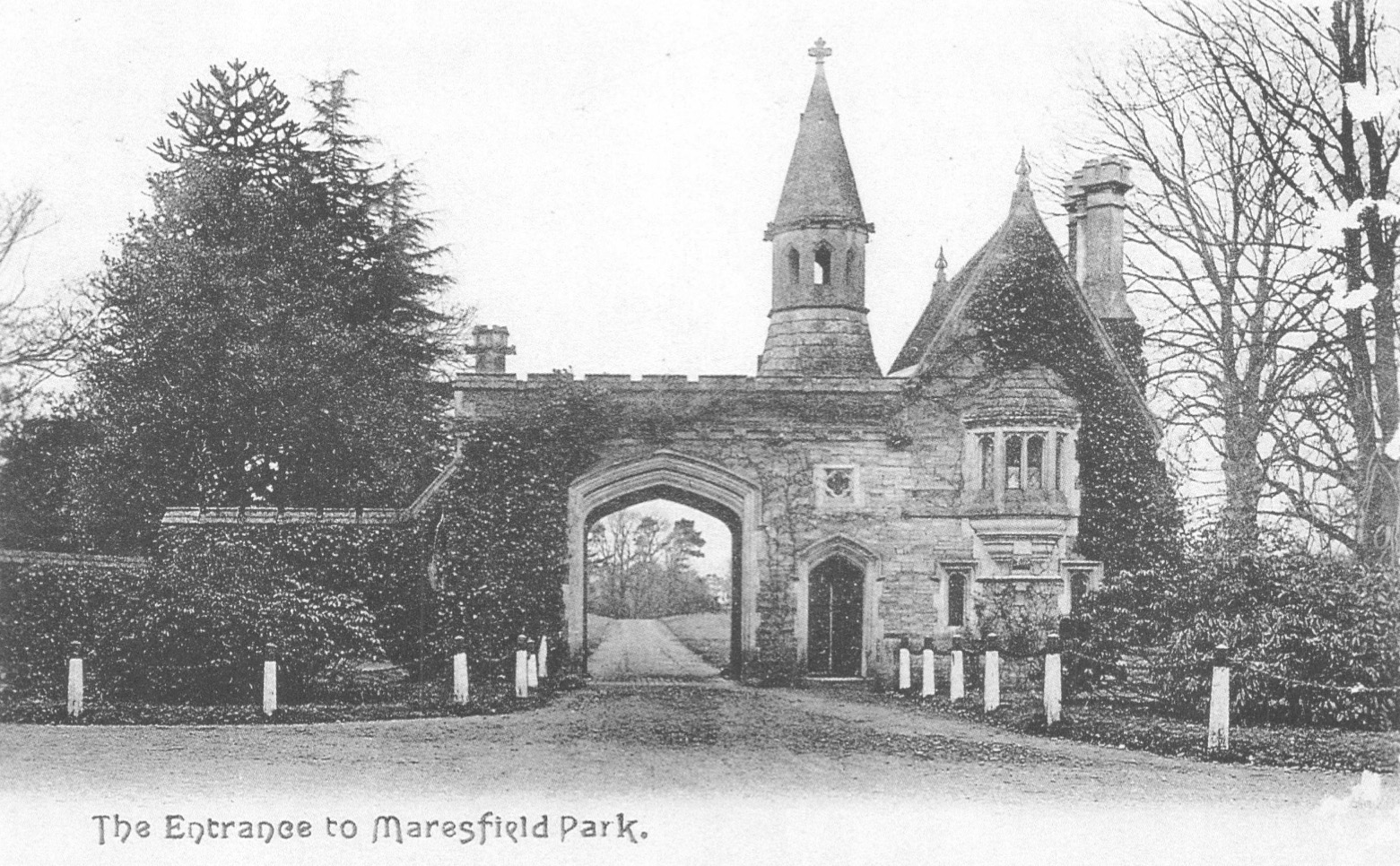
In 1814 Sir John Shelley and his wife Frances (the diarist of Regency society) inherited the Estate and spent £70,000 improving the main house, “The Cross” (the name being derived from the crossing of the tracks now represented by the modern drives).
The Park extended from the Piltown Road (Batts Farm) north to Horney Common.
Queen Victoria travelled via Batts Farm when she visited the Shelleys in 1845, when staying in Brighton. A fine avenue of oaks was planted in commemoration of the visit, some of which remain today.
The Duke of Wellington, said to be a fervent admirer of Lady Shelley, came in 1819 after the Battle of Waterloo and was given a hero’s welcome, when residents lined the roadsides to greet him.
Sir John passed the Estate to his son Sir John Villiers Shelley, Bart, M.P., on his marriage. There was no male heir and the Estate passed in turn to his daughter Lady Blanche Pechell, who died in 1898 without an heir.
Count and Countess Münster inherited Maresfield Park in 1898 and modernised the Estate, building in 1900 a grand new stable block (now three houses), an electrical power house and bungalow (now ‘Dalveen’). Their stewardship was brought to an abrupt end at the outbreak of war in August 1914, when they left Maresfield and the government confiscated their lands.
The Park became a military camp for the duration of the Great War. Again in the Second World War, the military returned to the village, this time the camp being sited in Batts Road, where it remained until closure about 1970.
In 1924 the Public Trustee sold the Park in lots and development started in a small way. After the Second World War Mr A.F. Green sold off his poultry farm for individual development and several larger houses sold surplus ground for building. In 1963 Henry Boot built a select development of Georgian houses in the main drive.
The church is in the centre of the village and has always been the focal point of village life.
In the reign of Henry I the present building replaced a wooden church probably used by visiting priests and Maresfield then had its own Rector. In 1375 the church was restored in Early English style. Early in the 15th century the square tower was added by John de Pelham, one of the powerful family of Sussex land owners who came over with William the Conqueror and built extensively in the area, leaving their insignia – a buckle – on many buildings.
Maresfield can trace its rectors back to 1404, two of whom left their mark deeply. The Reverend Richard Bonner was buried in the chancel in 1692, having left money for educational purposes and for a Bible (not exceeding eight shillings in value) to be given annually to a deserving child under 14 years of age. This charity money was later given to the village school, which still bears his name and on whose site his cottage stood.
The Reverend Algernon Charles Dudley Ryder was rector for nearly 40 years until his retirement in 1941.
Mr Ryder was a well-loved and respected figure in the village and an outstanding botanist. Many middle-aged residents are grateful to him for kindling a love of plant life and encouraging the collection of specimens in their formative years.
He was the last rector to fully occupy and raise his family in the Old Rectory, ‘a large and noble residence’ built about 1872 during the ministry of the Revd J.B.M. Butler. Part of the Old Rectory was mysteriously destroyed by fire in 1949, when a newer and smaller house was purchased for the Revd S.B. Latham.
Some landmarks have passed without trace, including the parish stocks, which were sited in what is now the cemetery.
The parish pound, to which straying cattle were driven, was opposite ‘Sandrock’ and is now part of the recreation ground. Underhill was the industrial area, where the tannery and forge flourished.
At the bottom of School Hill, by the mill pond (near Budletts Roundabout) was a water mill said to be one of the finest in Sussex, which was burnt down in 1870 and never replaced. Sussex trug baskets were made by Mr Avis at Maresfield who was apprenticed to Messrs. Smith at Herstmonceux. He won prizes at the Great Exhibition of 1851, which Queen Victoria attended and ordered one for each of her children.
Powder mills were erected on the site of one of the old forges but after several explosions causing loss of life, these were closed some twenty-five years later.
Sir John Villiers Shelley had the low wooden buildings removed to Flitterbanks Farm, where they served as cow sheds until recent times. The Maresfield Estate included lands within the parish of Fletching and a story is told that one day Prince Münster was out driving his four-in-hand at Piltown and stopped to ask a tenant farmer to whom the gorse and scrubland belonged. George Varnum replied and told the Prince it was part of his Estate. In disbelief he returned and had his title deeds checked and as a result Piltown Golf Course was made and opened in 1904. Among the notables who have played there was Lord Louis Mountbatten’s father.
Sussex has always been renowned for its smuggling activities. In the 18th century wool was smuggled out from the coasts between Birling Gap and Pett Level, whilst tobacco, spirits, tea and silks were brought in. Ashdown Forest, with its impassable roads, trees and hollows, provided a natural hideout for the smugglers and their goods en route to London. Two roomy vaults hewn out of sandstone near Flitterbanks Farm in Cave Woods were said to be smugglers’ hideouts.
The cave remains beside the new bypass road and now has the protection of an iron grille. Fifty years ago it was also a stopping place for ‘Moggie Mothballs’, who was well-known as a travelling lady dressed in black from top to toe, pushing a deep-welled pram in which she carried all her worldly goods, besides the mothballs from which she made her living (before the Welfare State!). She was killed on the road during the blackout in World War Two, and paper money was found sewn to the lining of her clothes.
Nearby, at “Lampool Lodge”, Miss Winifred Read, a most avid animal lover, lived. Goats, rabbits, cats and chickens shared her table and everyone with pet problems in the neighbourhood consulted her. She had two teeth, a trilby hat and dressed in manly attire, and was willing for an hour’s talk with anyone who passed by. The picturesque lodge in which Miss Read lived was demolished in the 1970s and a modern property erected on the site.
Sadly, today Maresfield has only two shops, as a result of the influence of the motor car and supermarket. Fifty years ago there was a butcher’s shop at “Prospect House” on the corner of the recreation ground, where Mr A.J.H. Bayley, a master butcher, ably served his public.
The Tester family had their Post Office Stores a few doors away. Mr C.A. Wickham and his father before him ran a thriving Village Stores on the opposite side of the road and gave employment to at least half a dozen people. Groceries, haberdashery and paraffin were delivered to a wide surrounding area.
Mr and Mrs Charles Brown worked and lived in the premises beside the Chequers Inn and their tobacconist’s was a meeting place. Later it was made into a lock-up shop and trading continued in the able hands of Mr F.J. Woodhams, a 1914/18 war veteran.
The Chequers Inn, a solid and interesting old building, where Mr Ernest Greenwood was licensee throughout the Second World War, played host to thousands of troops stationed at the camp, including men of many Canadian regiments, prior to raids and landings on the Continent.
King George VI inspected his troops on Maresfield Recreation Ground before the D-Day landings, on the same ground that Princess Victoria had planted a tree in 1897 to commemorate her mother’s Diamond Jubilee.
Mr R.E. Hammond and his family offered newspapers (marked up on top of the wartime Morrison shelter), tobacco and confectionery and bread (from W.B. Weekes Bakers in Uckfield) from 1 The Parade.
Dr Gainsborough was on hand at appointed times at 2 The Parade. Kay Clifton (followed by Miss W.H. Barlow, when she returned from the W.A.A.F. after the war) ran a busy hairdresser’s next door. 4 The Parade was one of five eating houses in the village. This was run by Mrs Flood and after the war became the Golden Wheel, aiming at the cyclist trade. The Chestnuts, The Cabin (transport café) and the Marigold at Lampool Corner all traded. The fifth was the Coffee Cup on the Straight Half Mile. The proprietors, Colonel and Mrs Hayes-Sadler, had premises both sides of the road. The café was where Uckfield Dairies now have their dêpot. Good English wholesome food was offered and the smells of bacon and mushrooms cooking often drifted along the highway. The Colonel and his wife were scholarly people and enjoyed conversing with their customers. On the opposite side of the road they sold vegetables and plants.
Mr and Mrs Claret ran the garage on the bend at the northern end of the Straight Half Mile and served petrol from hand pumps. Their invalid daughter Doris watched on from her wheelchair. Like the Colonel and Mrs Hayes-Sadler, the Clarets were gentlefolk, whose business was their life and their customers their friends. They all put in hours of service at their posts that would horrify staff today.
Mr W. H. Marsh had a dairy in the Park and delivered milk by van, but the centre of the village was mostly served by Mrs Daisy Brown of Tanyard Farm, Underhill, who pushed a milk churn up the steep hill in her pram and ladled the milk into her customers’ jugs.
She and her husband Alfred grazed their very small herd of about eight cows in the water meadows. Each cow was called for milking and the names echoed around. One was called Betty, which caused me much childhood embarrassment.
Now that the Bypass is open, no longer is the congregation of St Bartholomew’s Church subjected to the screeching brakes during matins as trippers make their way to the coast. Residents will no longer have to continually repair fences and walls knocked down by traffic taking the corner at too high a speed. Sadly the two Misses Burtenshaw who had a tank arrive in their dining room during the war have not lived to see this change.
Hopefully all heavy traffic will desert the village centre and peace and tranquility will return once more and the wonderful atmosphere of the Bypass Celebration, Saturday November 18th, 1989 always prevail.
Taken from “Maresfield”, by Betty Turner, 1991
Leave a Reply
You must be logged in to post a comment.