
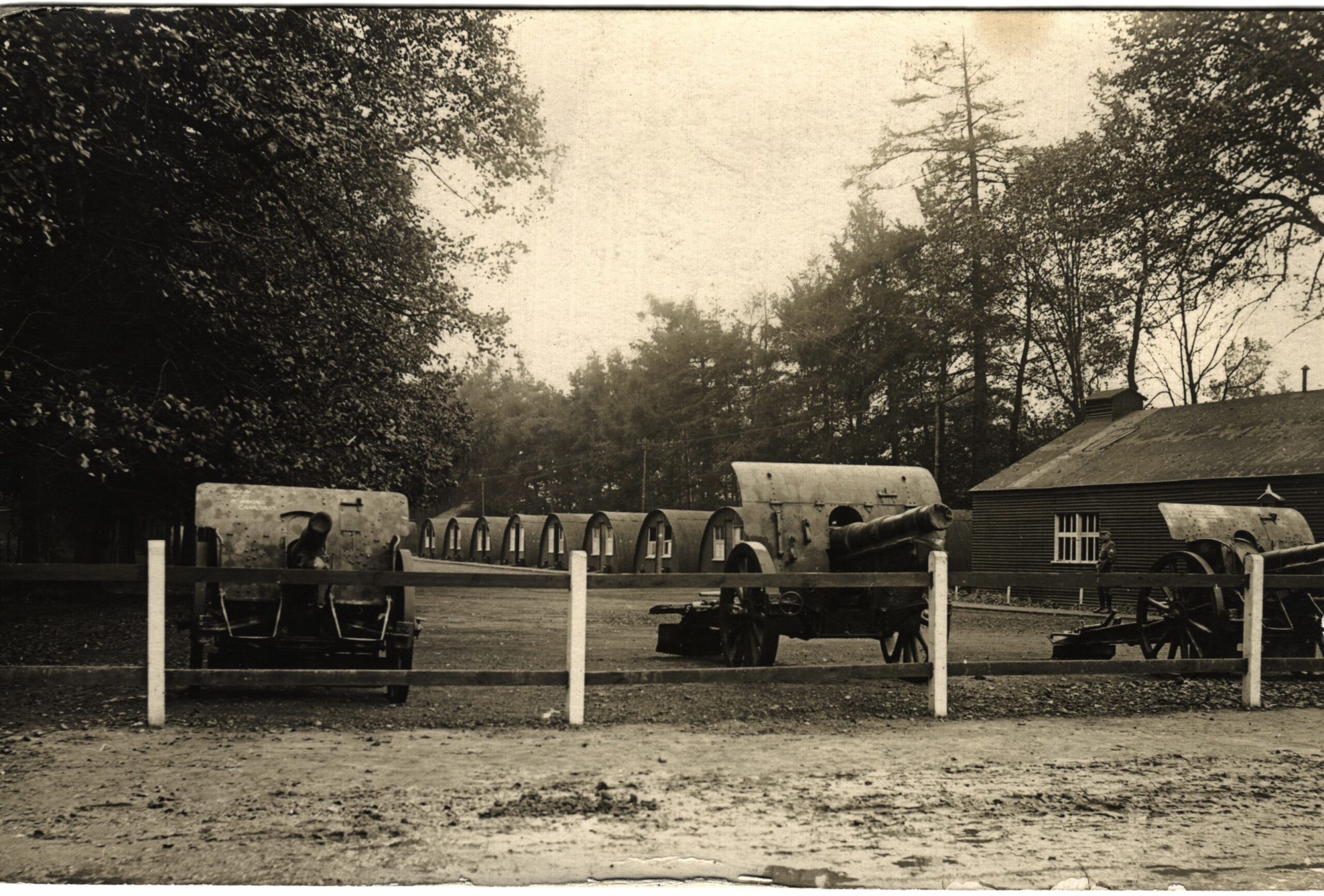
The UK Government confiscated Maresfield Park Estate from the German born owner, Prince Münster at the outbreak of the Great War in 1914 and it was turned into an army camp.

Nissen huts were erected on the open land. The guardroom was just to the right inside the archway at The Lodge, and sentries paraded outside.


The Canteen was situated in Batts Road, near where the first entrance to Parklands Estate was made in the 1950s. The tailor’s hut was on the site of ‘Frayles’ (Now ‘Fairhaven’), and the Y.M.C.A. hut in the meadow opposite.


‘The Manor House’ became the officers’ headquarters.

The stable block became home to the first lady soldiers, including a girl who was later to marry local farmer Alfred Brown and become a well known village personality as Daisy Brown.

The camp brought business to the district and Mr R. Reed of Uckfield remembers as a schoolboy of eleven or twelve helping to push an iron-wheeled cart full of freshly baked buns and cakes from Dadswells the Bakers in Framfield Road, Uckfield to the Y.M.C.A. for sale to the troops.
The army held Gymkhanas in the Park on their Open Days.

The Royal Corps of Signals was formed at Maresfield in 1920 from military personnel of the Royal Engineers.

Maresfield Park Camp was also home to the Queen Mary’s Auxiliary Army Corps, a female unit formed in 1917 to free up more men to go and fight abroad.


The camp in Maresfield Park was closed in 1924 and the Public Trustee then sold the Maresfield Estate. Local people bought the Nissen huts and many today still form the nucleus of rebuilt and enlarged properties.
Maresfield Camp in World War 2
The army returned to Maresfield in 1941 and the Second World War camp was in Batts Road, although immediately prior to D-Day a Canadian Regiment also camped under canvas in the main drive of Maresfield Park.


In 1941 ‘The Manor House’, ‘The Wilderness’ and ‘Hemimestone’ (now ‘The White House’) were requisitioned by the War Department for the offices of Commanding Royal Engineers and the Deputy Commanding Royal Engineers. The staff were civilian and military personnel and were engaged in planning the defence of Southern England.

A special drawing office was erected in the grounds of ‘The Manor House’ (where the property known as ‘Dendrons’ now stands). Security was very tight and the offices were never left unattended due to the highly secretive nature of the work.
Staff rose to their highest numbers prior to the D-Day landings and there was a good social atmosphere despite the shortages and blackout, including Christmas parties in the Village Hall. Tennis parties were held round the lake at ‘The Wilderness’ where the ground was covered with wild strawberries. Miss V.E. (Queenie) Body was the tennis captain, a very able player who had a doubtful claim to fame by having identified the tennis racquet of Emily Beilby Kaye (EBK) in the Crumbles Murder Case at Eastbourne in 1924 for which Patrick Mahon was hanged. After the war the houses in the Park were derequisitioned and the offices moved to Maresfield Camp in Batts Road.

King George VI inspected the troops on Maresfield Recreation Ground. His visit was a closely-guarded secret; the posters of the time told us ‘Careless talk costs lives’. However, Mr Charles Sears of the C.R.E. office was allowed to tell the Headmaster an hour in advance of the King’s arrival in order that the village school children did not miss the opportunity of seeing their sovereign. Mr A.J.H. Bayley, the village butcher at ‘Prospect House’, on the corner of the Recreation Ground was asked to vacate a room to allow the Bishop of Lewes to change his robes in privacy.
Maresfield Camp post World War 2
The camp finally closed in the 1970s after being ‘home’ for about 30 years to many English and Canadian Regiments and the Asian refugees who used it as a transit camp. They included the Royal Corps of Signals, the East Lancashires, the Intelligence Corps, OCTU (the Officer Cadet Training Unit) and the Royal Regiment of Canada to name but a few.
After the war 32 army houses were built as officers’ houses and married quarters on the opposite side of the road. When the camp closed these were taken over by Uckfield Rural District Council who after World War Two built the large housing estate in Batts Bridge Road known as Parklands.
Some former officer houses also remain in Queens Drive, on the eastern side of the A22 bypass.